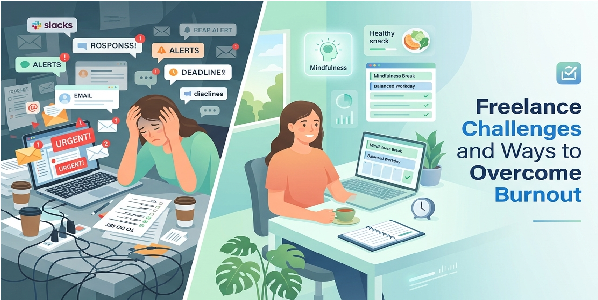
Freelance Challenges and Ways to Overcome Burnout
Introduction: The Dream of Freedom vs. The Reality of Burnout
Freelancing is often pictured as working in cozy cafes, waking up at any hour of the day, and having no boss. But behind this attractive facade lie hidden challenges that can push even the most motivated individuals to the brink of burnout. The blending of home and workspace, financial stress, and social isolation expose freelancers to immense psychological pressure. In this article, we take a scientific and structured look at these challenges and provide practical solutions to escape the burnout trap.
Part One: The Mathematical Model of the Freelancer Burnout Index
To better understand the mechanics of burnout, organizational psychologists and freelance experts have developed a formula called the Burnout Index ($B_{index}$). This model illustrates which variables push you toward extreme exhaustion and which factors serve a protective role:
$$B_{index} = \frac{(W_{load} \times I_{solation}) + U_{ncertainty}}{B_{oundaries} + R_{ecovery}}$$
- $W_{load}$: Workload and tightness of deadlines.
- $I_{solation}$: The degree of social isolation and lack of human interaction.
- $U_{ncertainty}$: Financial uncertainty and the stress of not having a next project.
- $B_{oundaries}$: Clear boundaries between work and personal life.
- $R_{ecovery}$: Time dedicated to rest and mental recovery.
This equation tells us that as workload, loneliness, and financial stress (the numerator) increase, burnout rises sharply; unless we proportionally increase the denominator, namely the boundaries between work and life and our recovery times.
Part Two: Core Challenges and Solutions to Overcome Them
1. The “Feast or Famine” Cycle (Financial Stress)
Challenge: In the freelance world, one month you might have so many projects that you can’t find time to sleep (feast), and the next month there is zero demand for your work (famine). This financial uncertainty ($U_{ncertainty}$) is one of the biggest stress factors.
Solution: The “Income Smoothing” technique. Always save at least 3 to 6 months of living expenses as an emergency fund. Furthermore, instead of relying on one-off projects, try to offer your services on a retainer basis or propose long-term contracts to clients.
2. Blurring Boundaries Between Work and Life (Endless Work)
Challenge: When your office is your bedroom or dining table, your brain cannot recognize the “end of shift” time. This leads to answering emails during rest hours and feeling like you are always working.
Solution: Use the “Fake Commute” technique. Before starting work, put on work clothes, take a 15-minute walk in the neighborhood, and then sit at your desk. At the end of the day, shut down the computer and leave the workspace. Creating distinct physical spaces ($B_{oundaries}$) is vital for the brain.
3. Social Isolation and the Cave Syndrome
Challenge: Humans are social creatures. The lack of casual daily conversations in the company pantry, joking with colleagues, and group brainstorming gradually leads to depression and reduced creativity.
Solution: Work from co-working spaces or busy cafes at least two days a week. Also, join virtual networks and freelance communities to stay connected with peers and share experiences.
Conclusion: Freelancing is a Marathon, Not a Sprint
Success in freelancing is not limited to having specialized skills; it also depends on your ability to manage your energy, time, and psychology. Burnout doesn’t happen overnight; it is the result of gradually ignoring human needs. By structuring your workdays, managing financial expectations, and paying attention to mental health, you can transform freelancing from a high-stress job into a sustainable and enjoyable lifestyle.
Frequently Asked Questions (FAQ)
1. What are the early signs of burnout in freelancers?
Chronic fatigue even after adequate sleep, cynicism toward clients and projects, chronic procrastination, declining output quality, and feeling anxious when opening work emails or messengers are among the most significant early signs.
2. How can we recover if we experience severe burnout?
The first step is accepting the problem and pausing temporarily. If possible, take absolute time off for a few days to a week and shut down your computer. Upon returning, limit your working hours, decline high-stress projects, and make sure to incorporate regular exercise and physical activity into your daily routine.