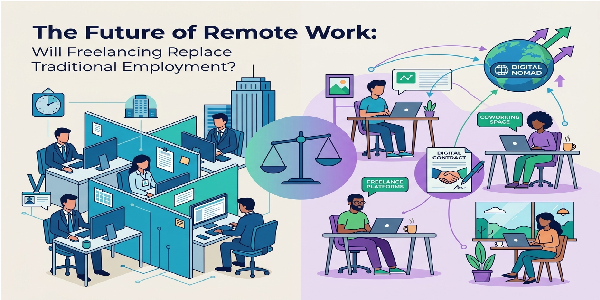
The Future of Remote Work: Will Freelancing Replace Traditional Employment?
Introduction: Crossing the Boundaries of the Office
The digital revolution and post-pandemic shifts have changed the definition of the “workplace” forever. The four walls of an office are no longer the only place to create value. Amidst this, two work models have become increasingly prominent: Traditional Employment, which has evolved towards remote work, and Freelancing, a symbol of independence and flexibility. The fundamental question preoccupying managers and the workforce is: Are we witnessing a temporary shift or a fundamental transformation where the project-based freelance economy pushes the long-term employment model to the margins? This article provides a deep analysis of this question.
Part 1: Clarifying Key Concepts
To analyze accurately, we must first understand the subtle differences between these concepts:
- Traditional Employment: A long-term relationship between employee and employer, accompanied by a fixed monthly salary, benefits (insurance, retirement), relative job security, and a specific organizational structure. Even if this employee works remotely, they are still an “employee.”
- Freelancing: A short-term, project-based relationship. A freelancer is an independent contractor working for multiple employers simultaneously or consecutively. They are responsible for managing their own business, including marketing, taxes, and insurance.
Key Point: Remote Work is a “place” or “method” of doing work, whereas Freelancing is an “employment status.” A full-time employee can be a remote worker, and a freelancer might work in a client’s office.
Part 2: Driving Forces Behind This Paradigm Shift
What factors have caused the explosive growth of the freelance economy?
1. Technological Advancements
Platforms like Upwork and Fiverr, communication tools like Slack and Zoom, and project management software like Trello and Asana have eliminated geographical barriers, easily enabling collaboration between a company in New York and a specialist in Tehran.
2. Cultural and Generational Changes
New generations (Millennials and Gen Z) value “Work-Life Balance,” independence, and flexibility more than previous generations. They are willing to trade traditional job security for freedom and control over their professional lives.
3. Economic Benefits for Companies
Reducing overhead costs (office rent, bills), accessing a Global Talent Pool without geographic restrictions, and agility in hiring specialists for specific projects have made freelancing a smart strategy for businesses.
Part 3: Mathematical Modeling – Risk and Reward Analysis
Choosing between employment and freelancing is a trade-off between stability and growth potential. We can model the Expected Value of income for each path:
Traditional Employment Income Model
$$ E(I_{\text{trad}}) = S_{\text{annual}} + B – T – C_{\text{work}} $$
In this model, $S$ is the fixed annual salary, $B$ is potential bonuses, $T$ is taxes, and $C$ represents work-related costs (like commuting). The main characteristic of this model is low volatility and high predictability.
Freelancing Income Model
$$ E(I_{\text{free}}) = \sum_{i=1}^{n} (R_i \times H_i) \times P(\text{win}_i) – C_{\text{biz}} – T_{\text{self}} $$
Here, income is the sum of revenues from all projects ($n$), each being the product of the hourly rate ($R_i$), working hours ($H_i$), and the probability of winning the project ($P(\text{win}_i)$). From this revenue, business expenses ($C_{\text{biz}}$) and self-employment taxes ($T_{\text{self}}$) must be deducted. The main characteristic of this model is high volatility and unlimited income potential.
Comparing these two formulas shows that freelancing is a higher-risk game with greater potential rewards, while traditional employment reduces risk in exchange for capping the reward.
Part 4: Challenges and Obstacles on the Path to Complete Replacement
Despite the growth of freelancing, completely replacing traditional employment faces serious challenges:
- For Freelancers: Lack of employment benefits (health insurance, retirement), severe income volatility, the need for continuous marketing to find projects, and feelings of isolation and loneliness.
- For Companies: Maintaining organizational culture, transferring Tacit Knowledge, security concerns regarding sensitive data, and legal/tax complexities when working with international freelancers.
- For Society: Weakening of social safety nets built upon the traditional employment model, and the potential for increased income inequality.
Part 5: What Will the Future Look Like? The Emergence of Hybrid Models
The future will not be a binary choice between these two models. The most likely scenario is the emergence and expansion of hybrid models:
Organizations will have a Core Team of full-time strategic employees responsible for maintaining culture, long-term strategy, and knowledge management. This core will be surrounded by a Flexible Network of freelancers and project specialists deployed for specialized tasks, short-term projects, and during peak workloads. This approach grants companies both stability and agility.
Conclusion: Not a Replacement, but a Convergent Evolution
Freelancing is not going to “destroy” traditional employment; rather, it will “complement” and force it to “evolve.” The future of work is a spectrum, not a dichotomy. On one end of the spectrum, traditional employment retains its appeal by adding more flexibility (like remote work and flexible hours). On the other end, the freelance ecosystem becomes more stable by creating better support structures (like insurance and retirement platforms for independent workers). Ultimately, both companies and the workforce will win, as they will have more choices to build a work model tailored to their needs.
Frequently Asked Questions (FAQ)
1. Does every job have the potential to become freelance?
No. Jobs that require constant physical presence, access to specific equipment, or a high level of instantaneous collaboration and brainstorming (like surgery or production line management) are less compatible with the freelance model. Knowledge-based and digital jobs (like programming, design, and marketing) are the best candidates.
2. What is the biggest risk for a company that relies too heavily on freelancers?
The loss of organizational memory and tacit knowledge. When a project ends, freelancers take the knowledge and experience gained with them. Companies must have mechanisms in place to document and transfer this knowledge to their core team.