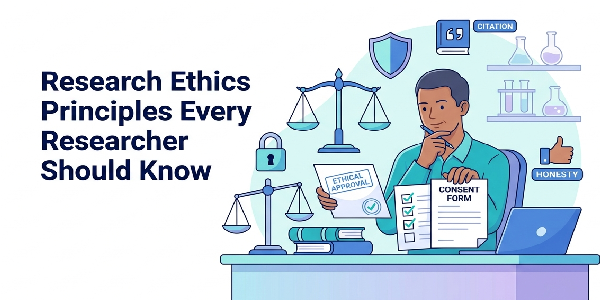
Research Ethics Principles Every Researcher Should Know
Introduction: Why is Research Ethics Crucial?
The progress of science is built on trust. Society trusts research results to make important decisions in medical, engineering, humanities, and policy-making fields. Research Ethics is a set of principles and guidelines ensuring that scientific research is conducted with honesty, respect for the rights of others, and without bias. Ignoring these principles not only destroys the researcher’s credibility but can also cause irreparable damage to society and the environment.
1. Honesty and Transparency (Preventing Fabrication and Falsification)
The most important principle in any research is the honest reporting of data, results, methods, and procedures. Two major violations in this area are:
- Fabrication: Making up data or results that never existed and recording them as real findings.
- Falsification: Manipulating research materials, equipment, or processes; or intentionally changing and omitting data so that the final result does not match reality.
A Statistical Look at Research Fraud: P-Hacking
One instance of ethical violation in data analysis is statistical manipulation to achieve significance (P-Hacking). Suppose a researcher uses an independent T-test to compare two groups. The formula is as follows:
$$t = \frac{\bar{X}_1 – \bar{X}_2}{\sqrt{\frac{s_1^2}{n_1} + \frac{s_2^2}{n_2}}}$$
In this formula, $n_1$ and $n_2$ are the sample sizes of the two groups. Dishonest researchers might intentionally remove outliers (without scientific justification) or stop data collection as soon as the $p-value$ drops below $0.05$, artificially reducing the denominator and increasing the $t$ value. This is a clear ethical violation because it falsely presents the results as “significant”.
2. Plagiarism
Using someone else’s ideas, words, designs, or data without proper citation is considered plagiarism. Even using your own previous writings without citation (Auto-plagiarism) is a violation according to reputable journals.
3. Respecting the Rights of Human and Animal Subjects
Research conducted on humans or animals carries extremely high sensitivities:
- Informed Consent: Participants must be informed of all the risks, benefits, and objectives of the research and willingly sign a consent form.
- Confidentiality: The identity of participants and their personal data must remain completely confidential.
- Animal Ethics: Adhering to the 3Rs principle (Reduction in the number of animals, Replacement of methods where possible, and Refinement of conditions to minimize pain and suffering).
4. Conflict of Interest
A conflict of interest occurs when a researcher’s financial or personal interests could influence their professional judgment in designing, conducting, or reporting research. Having a conflict of interest is not a crime in itself, but hiding it is a major violation. Researchers are obligated to declare funding sources and any financial connections with companies related to the research topic in their article.
Conclusion
Adhering to research ethics principles is not a limitation, but a framework that gives identity and credibility to science. Researchers, as pioneers of knowledge production, have a duty to maintain the highest ethical standards at all stages of their work, from ideation to the publication of results. Obtaining approval from the university or institute’s ethics committee before starting any study is the first step on this path.
Frequently Asked Questions (FAQ)
1. What should we do if we notice an ethical violation in another researcher’s article?
If you observe obvious violations such as plagiarism or data fabrication in published articles, you can correspond with the journal’s Editor-in-Chief, providing detailed documentation. Journals are obliged to investigate these claims.
2. Is using Artificial Intelligence (like ChatGPT) in writing an article considered plagiarism?
Generating the entire text with AI and claiming ownership of it is considered an ethical breach by most reputable journals. However, using these tools for grammatical editing, improving tone, and brainstorming is usually acceptable, provided there is full transparency in the methodology or acknowledgments section.
3. What is an Ethics Code and how should it be obtained?
An ethics code is a unique identifier issued by the research ethics committee of universities or research centers. To obtain it, you must submit your project proposal (specifying how subjects’ rights will be respected) to this committee before starting data collection.