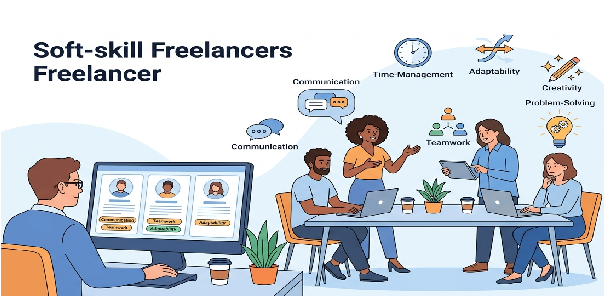
Soft Skills You Must Look For When Hiring a Freelancer
Introduction: Why Are Soft Skills Crucial in 2026?
In the dynamic world of freelancing in 2026, technical expertise (Hard Skills) is only half the equation for project success. With the expansion of AI tools and automation, many technical tasks are done much faster; but what distinguishes an ordinary freelancer from an exceptional one is Soft Skills. Soft skills include personality traits, emotional intelligence, communication style, and problem-solving ability in critical situations. In this comprehensive article, we will examine the most important soft skills employers should consider in the freelancer hiring process.
1. Effective and Clear Communication
The biggest challenge in remote work is communication misunderstandings. Freelancers must be able to convey their ideas, questions, and challenges clearly and transparently.
- Timely Responsiveness: Is the freelancer available during agreed-upon times and responsive to messages?
- Ability to Ask the Right Questions: A professional freelancer resolves project ambiguities by asking precise questions before starting work to avoid rework.
- Regular Reporting: Providing continuous updates on project progress shows respect for the employer’s time and concerns.
2. Time Management and Self-Organization
Freelancers are their own managers, and there is no direct supervisor or attendance system looking over their shoulders. Therefore, the ability to manage time and meet deadlines is an absolute necessity. A freelancer who cannot manage their time, regardless of their level of technical expertise, will cause the project to fail.
3. Problem Solving and Critical Thinking
Unforeseen problems can occur in any project. Ideal freelancers are those who, instead of stopping work and waiting for moment-by-moment guidance from the employer, use critical thinking to find alternative solutions. They have a proactive approach and are solution-oriented.
Mathematical Modeling for Evaluating Freelancer Skills
To take freelancer hiring out of an emotional state and turn it into a data-driven process, you can use weighted scoring models. Suppose we denote the overall score of a freelancer by $S_{total}$. This score is a combination of hard (technical) skills and soft skills:
$$S_{total} = \alpha \sum_{i=1}^{m} (H_i) + \beta \sum_{j=1}^{n} (S_j)$$
In this formula:
- Variable $H_i$: Hard Skills score.
- Variable $S_j$: Soft Skills score (such as communication, problem-solving).
- Coefficients $\alpha$ and $\beta$: The weights assigned to hard and soft skills. In long-term team projects, the value of $\beta$ (weight of soft skills) is usually considered equal to or even greater than $\alpha$ (e.g., $\beta = 0.6$ and $\alpha = 0.4$).
4. Adaptability and Flexibility
Sometimes midway through, project requirements change, or employer feedback requires major revisions to the work. A freelancer with adaptability skills does not put up their guard against changes and can quickly align themselves with the new project path. Receiving and applying feedback without personal defensiveness is a sign of professional maturity.
5. How to Evaluate These Skills Before Hiring?
Evaluating soft skills from a resume is difficult. To assess these skills, you can use the following methods:
- Small Test Projects: Define a small, time-bound task (e.g., 48 hours) to gauge their communication, time management, and work quality in practice.
- Short Video Interviews: A 10-minute call can give you a lot of information about the freelancer’s tone, confidence, and communication skills.
- Behavioral Questions: Ask in a chat or interview: “How would you react if you were approaching a project deadline and your system crashed?” The answer to this question determines their problem-solving skill.
Frequently Asked Questions (FAQ)
Are soft skills learnable?
Yes, skills like time management or effective communication are entirely acquirable, but learning them requires time, practice, and self-awareness from the freelancer.
What if a freelancer has excellent expertise but poor soft skills?
For short-term, one-off projects that require little interaction, it might be tolerable. But for team, sensitive, and long-term projects, a lack of soft skills will definitely lead to failure and friction.
Conclusion
Hiring a freelancer in the modern world is not just buying a technical service; it is adding a temporary partner to your team or business. Paying attention to soft skills like clear communication, time management, flexibility, and critical thinking minimizes the risk of outsourcing and creates an enjoyable and efficient experience for both parties (employer and freelancer). By using precise evaluation methods and scoring models, you can identify and attract the best talent for your projects.