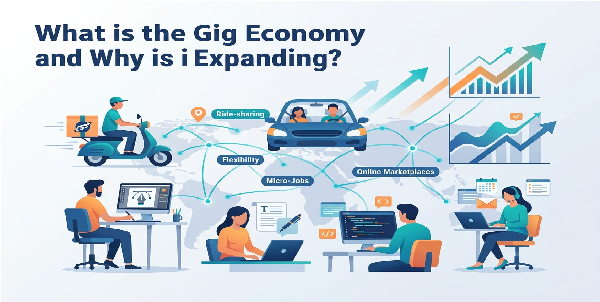
What is the Gig Economy and Why is it Expanding?
Introduction: The End of the Traditional Employment Era?
Have you ever wondered why more and more people are leaving standard office jobs with fixed hours (9 to 5) and turning to project-based, freelance, and part-time work? The answer lies in a phenomenon economists call the Gig Economy. In the gig economy, jobs are temporary and flexible, and organizations contract with independent contractors and freelancers instead of hiring full-time employees. This article provides a deep dive into this concept, the reasons behind its explosive growth, and its impact on the future of work.
What Exactly is the Gig Economy?
The word “gig” was originally used by jazz musicians to refer to temporary live performances. Today, this term has expanded to include any type of temporary, project-based, or freelance work. Uber and Lyft drivers, graphic designers on freelance platforms, project-based programmers, and even part-time consultants are all pillars of this new economy. The main characteristics of this economy are work independence and the absence of long-term commitment between the employer and the workforce.
Reasons for the Rapid Expansion and Growth of the Gig Economy
The growth of the gig economy is no accident; rather, it is the result of the convergence of several technological, economic, and social factors:
- Advancement of Digital Platforms: The emergence of intermediary applications and platforms (like Upwork, Fiverr, Uber) has made connecting demand (customers) and supply (workforce) possible in a fraction of a second.
- Desire for Flexibility and Independence: New generations (Millennials and Gen Z) highly value work-life balance. They want to choose their own working hours and locations.
- Cost Reduction for Businesses: Hiring a full-time employee involves hidden costs such as insurance, office space, equipment, and taxes. In the gig economy, companies only pay for the “result of the work.”
- Post-COVID-19 Pandemic Impacts: The pandemic proved to the world that many jobs do not require physical presence. This shift in mindset acted as a massive catalyst for remote and project-based work.
Mathematical and Economic Analysis: The Income Model in the Gig Economy
To better understand the economic appeal (and simultaneous risks) of the gig economy, we can mathematically model a gig worker’s net income. Unlike an employee with a fixed monthly salary ($S$), a freelancer’s income follows this relationship:
$$ Net\_Income = \sum_{i=1}^{n} (P_i \times Q_i) – C_{fixed} – C_{variable} $$
In this equation:
- $n$ is the number of projects or tasks completed in a given time period.
- $P_i$ is the agreed price or wage for the $i$-th project.
- $Q_i$ is the amount of work or hours spent on that project.
- $C_{fixed}$ is the freelancer’s fixed costs (such as internet bills, software subscriptions, and laptop depreciation).
- $C_{variable}$ is the variable costs (such as freelance platform commissions or gas money for drivers).
This formula shows that if a worker can increase the value of $P_i$ through high expertise and increase the number $n$ through time management, their income can exponentially surpass a traditional fixed salary. However, if market demand drops ($n \to 0$), income falls sharply, indicating the inherent risk of this economy.
Pros and Cons of the Gig Economy
Like any other economic phenomenon, the gig economy is a double-edged sword:
Advantages:
- Being your own boss and having full control over your work schedule.
- The possibility of having diverse income streams (reducing the risk of dependency on a single employer).
- The opportunity to work with international clients and enter global markets.
Disadvantages:
- Lack of employment benefits such as health insurance, paid leave, and retirement plans.
- Income instability and the stress of finding the next project.
- Feelings of isolation due to the lack of presence in team and corporate environments.
Conclusion: What Will the Future of Work Look Like?
The gig economy is not a passing trend, but a fundamental paradigm shift in how we define “work.” With the advancement of artificial intelligence and automation, it is expected that routine administrative tasks will decrease, and the need for specialized, project-based skills will increase. Governments and policymakers must also keep pace with this change and create new support networks (such as specialized insurance for freelancers) so that the workforce in this emerging economy has adequate security.
Frequently Asked Questions (FAQ)
1. What is the main difference between a freelancer and a gig worker?
These two terms are often used interchangeably. However, freelancers typically perform more specialized and knowledge-based work (like programming or design), while gig workers may also include micro-physical service-based jobs (like couriers or ride-share drivers).
2. Is the gig economy suitable for beginners?
Yes, this economy is a great platform for gaining experience, building a portfolio, and connecting with various employers. Beginners can start with small projects and gradually increase their skills and wage rates.
3. What is the biggest challenge in the gig economy?
Financial management and personal branding. In a traditional economy, the company finds work for you, but in the gig economy, you are simultaneously the expert, the marketer, and your own accountant.