A Comprehensive Guide to Writing a Winning Freelance Proposal
Introduction: The Proposal, Your Bridge to a Dream Income
In the highly competitive world of freelancing, your technical skill is only 50 percent of the path to success. The other 50 percent is your ability to sell this skill to the client. Your primary tool in this sales process is nothing other than a powerful Proposal or Cover Letter. A winning proposal can lead a freelancer with average skills to a high income, while a weak proposal leaves the most skilled professionals isolated in unemployment.
Part One: Client Psychology (What Exactly Are They Looking For?)
Before writing even a single word, you must put yourself in the client’s shoes. A client who posts a project on platforms like Upwork, Freelancer, or Fiverr is usually facing problems such as lack of time, budget constraints, or a lack of technical knowledge. They are not looking for someone who just lists their skills; they are looking for a Problem Solver.
- Trust and Confidence: The client wants to know if they can entrust their money and project reputation to you.
- Accurate Understanding of the Concern: Have you actually read the Job Description, or did you just copy and paste a pre-written text?
- Return on Investment (ROI): Does hiring you create financial or time value for them?
Part Two: The Anatomical Structure of a Winning Proposal
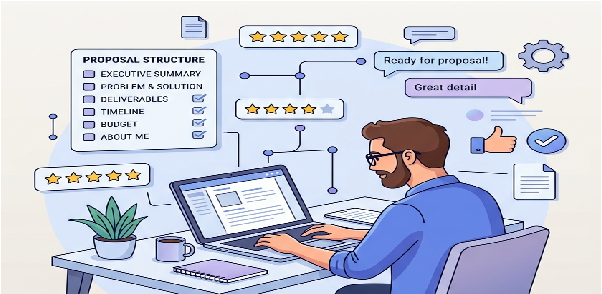
A standard proposal must follow a psychological and logical structure. This structure includes 4 main parts:
1. The Hook: The First Two Golden Lines
On most platforms, the client only sees the first 2 or 3 lines of your message in the proposal list. If these two lines are not engaging, your proposal will never be opened. Never start with “Hi, I am [Name] and I have 5 years of experience.” Instead, shoot straight for the heart of the problem.
2. The Body and Solution (The Solution)
Now that you have caught their attention, you need to show how you intend to solve the problem. Briefly outline your execution steps. Use technical terms moderately to prove your expertise, but don’t speak so complexly that it confuses the client.
3. Social Proof & Portfolio
Claiming is easy; proving is hard. In this section, you should attach 1 to 3 portfolio items that are exactly relevant to the client’s needs. Sending dozens of irrelevant links will only frustrate the client.
4. Call To Action (CTA)
Do not end the proposal with a passive conclusion like “I hope you like my profile.” Take control of the conversation and invite the client to the next step.
Part Three: The Mathematical Model of Proposal Conversion Rate
To optimize the proposal submission process, sales engineers use a mathematical model. Your proposal conversion rate (the probability of getting the project), denoted as $CR$, follows this equation:
$$CR = \frac{R_{elevance} \times V_{alue}}{C_{ompetition} \times P_{rice}}$$
- $R_{elevance}$: How closely your expertise and proposal align with the client’s exact needs.
- $V_{alue}$: The value you create beyond expectations (like free consultation or faster delivery).
- $C_{ompetition}$: The number and skill level of other freelancers who have submitted proposals.
- $P_{rice}$: The client’s sensitivity to your proposed budget compared to the market.
As the equation shows, the more you increase the numerator (Relevance and Value), the more you can neutralize the destructive effect of the denominator (high Competition or higher Price) and increase your chances of success ($CR$).
Part Four: Deadly Mistakes in Writing a Proposal
- Copy-Pasting: Clients can smell pre-written proposals from miles away. This shows disrespect for the client’s time.
- Talking Too Much About Yourself (I-Syndrome): Instead of repeatedly using the word “I”, use “You” and “Your project”.
- Spelling and Grammatical Errors: A proposal full of mistakes sends a hidden message: “I am a careless person.”
- Illogical Pricing: Offering half the market price doesn’t always work; sometimes it makes the client suspicious of your work quality.
Part Five: SEO and Keywords on Freelance Platforms
The algorithms of platforms like Upwork work based on keywords. When a client posts a project titled “React.js Developer”, the algorithm displays proposals that contain these keywords organically in their text higher in the rankings. Be sure to extract the keywords present in the client’s project description and subtly repeat them in your proposal.
Conclusion: Consistency is the Golden Key
Writing a winning proposal is an art acquired through practice. Don’t expect to be hired immediately after sending 3 proposals. Successful freelancers have usually sent hundreds of proposals to find their magical tone formula. Every rejected proposal is valuable data for improving the next one. By following the provided structure, personalizing messages, and deeply understanding the client’s needs, your proposal conversion rate will soon increase dramatically.
Frequently Asked Questions (FAQ)
1. What is the ideal length for a freelance proposal?
The best proposals are neither too short nor too long. Between 100 and 250 words usually gets the best feedback. Long enough to show expertise, and short enough not to bore the client.
2. What if I don’t have a relevant portfolio?
Be honest! Say: “I haven’t done exactly this before, but I have the foundational skills for it and I am willing to test a small part of the work for you for free as a sample.” This technique reduces the client’s risk to zero.