How Has Artificial Intelligence Changed the Freelancer Hiring Process?
Introduction: The AI Revolution in HR and the Gig Economy
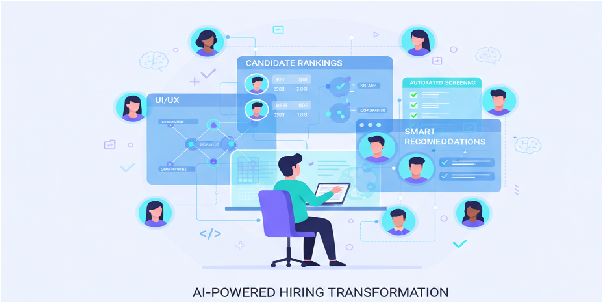
With the rapid growth of the Gig Economy, finding the right freelancer in a short time has become a major concern for employers. In the past, the process of reviewing resumes, evaluating portfolios, and interviewing hundreds of applicants was highly time-consuming and costly. Today, however, Artificial Intelligence (AI) acts as a powerful catalyst, transforming all stages of hiring, from initial screening to skill matching. Freelance platforms, by integrating machine learning algorithms, have made the search and hiring process smarter, faster, and more accurate than ever.
Part One: Key Impacts of AI on Hiring Freelancers
AI optimizes the job search and hiring process through various tools and capabilities:
- Automated Resume Screening: Natural Language Processing (NLP) algorithms can read thousands of proposals and resumes in seconds, extracting relevant keywords, skills, and experiences.
- Smart Matchmaking: Platforms like Upwork and Fiverr use AI to analyze the employer’s work history and freelancers’ profiles to automatically suggest the best matches.
- Automated Skill Assessment: AI-based skill assessment tests can dynamically adjust the difficulty of questions based on the freelancer’s answers, accurately measuring their level of expertise.
- Project Success Prediction: By analyzing historical data, AI can predict the probability of a freelancer’s success in a specific project, reducing hiring risks.
Part Two: Mathematical Modeling of Hiring Efficiency with AI
To better understand the added value of AI, we can mathematically model the Hiring Efficiency index. Suppose hiring efficiency depends on the quality of the selected candidate and the time and financial costs involved.
Hiring Efficiency (HE) Function
$$ HE = \frac{\sum_{i=1}^{n} Q_i}{(T_{screen} + T_{interview}) \times C_{hire}} \times \lambda_{AI} $$
In this equation:
$HE$: Total hiring process efficiency
$Q_i$: Output quality of the freelancer (based on skill scoring and matching)
$T_{screen}$: Time spent on screening
$T_{interview}$: Time spent on interviewing and evaluation
$C_{hire}$: Cost allocated for recruitment
$\lambda_{AI}$: AI acceleration coefficient (which is usually a number greater than 1).
With the introduction of AI, the $T_{screen}$ variables drastically decrease, and $Q_i$ increases due to more accurate matching, ultimately leading to exponential growth in $HE$.
Part Three: Challenges and Limitations of AI in HR
Despite all the benefits, using AI comes with challenges. Algorithmic Bias is one of the most significant risks; if AI is trained on inappropriate data, it may discriminate in selecting freelancers. Additionally, the loss of the Human Touch in evaluating soft skills, such as emotional intelligence and communication ability, is another weakness of fully automated systems.
Conclusion
AI is not meant to replace the final decision-making of employers; rather, as a super-smart assistant, it eliminates repetitive and time-consuming tasks. By using AI-equipped platforms, employers can focus on the more human and strategic aspects of hiring and bring the best freelancers into their teams with unprecedented speed and accuracy.
Frequently Asked Questions (FAQ)
1. Can AI assess freelancers’ soft skills?
Currently, assessing soft skills is difficult for AI. Although there are tools for analyzing tone and text-based communication, a final human interview remains essential for accurately measuring interpersonal communication.
2. How can freelancers optimize their profiles for AI algorithms?
Freelancers should use exact keywords related to their expertise in their profiles, have categorized portfolios, and write their proposal descriptions clearly and unambiguously so that Natural Language Processing (NLP) engines can easily recognize their skills.