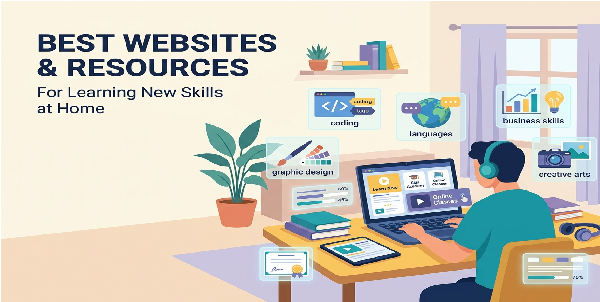
Best Websites and Resources for Learning New Skills at Home
Introduction: The Transformation of Education in the Digital Age
In today’s fast-paced world, continuous learning is no longer just an option, but a necessity for survival in the job market and personal development. With the expansion of the internet and the rise of E-Learning platforms, physical presence in traditional classrooms is no longer required. You can sit at home and learn new skills from the world’s best universities and experts. In this comprehensive article, we explore the best websites and resources for learning new skills at home and examine their effectiveness.
Part One: Introduction to Top Online Educational Platforms
Educational websites are divided into different categories depending on the type of skill you intend to learn:
- Coursera: The best choice for university-level courses. This platform collaborates with top universities like Stanford and Yale and offers valid certificates.
- Udemy: The largest marketplace for online courses where you can find a course for almost any skill (from programming to cooking). Courses are usually reasonably priced.
- edX: Similar to Coursera, edX was founded by Harvard and MIT universities and has a strong focus on basic sciences, engineering, and humanities.
- Skillshare: A paradise for creative individuals! If you are looking to learn design, graphics, photography, and content creation, this platform with its project-based approach is the best option.
- Codecademy: One of the best interactive resources for learning programming languages and data science practically and step-by-step.
Part Two: Mathematical Modeling of Online Learning Efficiency (Learning Curve)
To better understand the effectiveness of self-taught learning at home, we can use the mathematical model of the “Ebbinghaus Learning Curve” combined with online education indicators. Suppose the level of mastery of a skill depends on practice time and resource quality.
Skill Mastery Function
$$ S(t) = S_{max} \times \left(1 – e^{-k \cdot t \cdot Q_r}\right) $$
In this equation:
$S(t)$: The level of skill mastery at time $t$
$S_{max}$: Maximum learning capacity or full mastery (usually 100% or 1)
$k$: The individual’s intrinsic learning rate
$t$: Time spent learning at home
$Q_r$: The quality coefficient of the educational resource (e.g., a platform like Coursera has a higher coefficient than scattered YouTube videos).
This formula shows that by using high-quality resources (high $Q_r$), reaching the asymptote $S_{max}$ (full mastery) occurs in a much shorter time.
Part Three: Tips for Success in Learning at Home
Learning at home has its own challenges, including distractions and a lack of motivation. To overcome these challenges:
- Apply the Pomodoro Technique: 25 minutes of full focus followed by a 5-minute break.
- Learn Project-Based: Passively watching videos is not enough; implement new skills immediately in a small project.
- Create a Dedicated Environment: Dedicate a space in your home solely for learning to condition your mind.
Conclusion
Choosing the right platform for learning at home depends on your goals, budget, and learning style. Whether you are looking for career advancement with valid certificates (Coursera) or want to learn practical skills at a low cost (Udemy), the internet is full of incredible opportunities. The key to success is consistency and utilizing high-quality resources.
Frequently Asked Questions (FAQ)
1. Are certificates from online learning sites valid for employment?
Yes, many modern employers consider certificates from platforms like Coursera and edX to be valid, especially in technology and programming fields, provided they are accompanied by a portfolio of practical work.
2. What is the best free site for learning new skills?
YouTube is the largest and best free resource. Additionally, platforms like Khan Academy and the free sections of Coursera (Audit mode) are fantastic options.