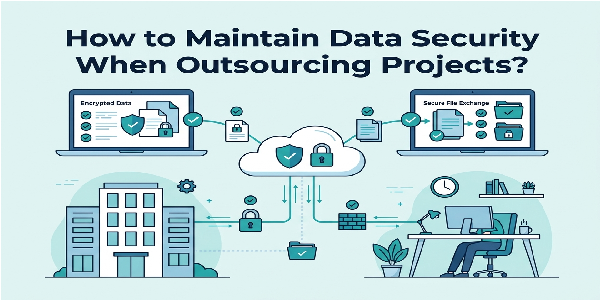
How to Maintain Data Security When Outsourcing Projects?
Introduction: Security Challenges in the Era of Freelancing and Outsourcing
In today’s fast-paced business world, project outsourcing and working with freelancers have become a key strategy for reducing costs and accessing global expertise. However, opening the company’s digital doors to individuals outside the organization carries significant security risks. Leaks of sensitive information, intellectual property (IP) theft, and unauthorized access are among the nightmares managers face. In this comprehensive article, we explore practical and proven solutions for maintaining data security during outsourcing, so you can entrust your projects to external professionals with peace of mind.
1. The Biggest Security Threats in Working with Freelancers
Before we can protect our data, we must know what threats endanger it. Some of the most common security threats in outsourcing include:
- Unintentional Data Leaks: Freelancers using public, unsecured Wi-Fi networks or malware-infected devices.
- Over-privileged Access: Granting cloud or server access to a freelancer far beyond what is needed to complete the task.
- Non-compliance with Encryption Standards: Transferring sensitive files via unsecured messengers or unencrypted emails.
Mathematical Risk Calculation: Threat Modeling
In information security management, risk is not just an abstract concept; it is calculable. The classic risk assessment model is defined as follows. If we denote the overall risk as $R$, this value equals the probability of the threat occurring ($P$) multiplied by its impact or damage ($I$):
$$R = P \times I$$
In outsourcing projects, the variable $P$ (probability of occurrence) increases due to the lack of physical control over the freelancer and their systems. If you simultaneously grant access to the entire database (high $I$), the risk ($R$) becomes highly critical. The security strategies introduced below aim to reduce the value of $P$ through security protocols and the value of $I$ by restricting access.
Essential Actions Before Starting the Project (Contract Phase)
Signing a Non-Disclosure Agreement (NDA)
No project should begin before signing a valid NDA (Non-Disclosure Agreement). This contract, which must be drafted legally and transparently, obligates the freelancer to keep all project information, customer data, and source codes confidential. Mentioning financial penalties and legal prosecution in case of breach of contract is an important deterrent.
Background Checks and Identity Verification
Using reputable freelance platforms with strong KYC (Know Your Customer) systems helps you ensure the individual’s true identity. Reviewing feedback from previous employers (Reviews) can give you a good perspective on the freelancer’s trustworthiness and professional behavior.
During the Project: Access and Infrastructure Management
Principle of Least Privilege
One of the golden rules of information security is this: give each person only as much access as they need to perform their duties. If a freelancer only needs to work on the user interface (UI) design, there is no reason for them to have access to backend source codes or customer databases. Use Identity and Access Management (IAM) systems to precisely control these permissions.
Using Isolated Work Environments (Sandboxing)
Instead of sending original organizational files to the freelancer, create testing and development environments (Staging/Sandbox). Use Mock Data in these environments so that even if the freelancer’s system is hacked, your actual customer data is not compromised.
Encrypted Communication and File Transfer Tools
Avoid sending passwords or sensitive files on WhatsApp or Telegram. Use password managers like Bitwarden or 1Password to securely share passwords. For file transfers, utilize reputable cloud services that offer End-to-End encryption.
After Project Completion: Cleanup and Revoking Access
Information security doesn’t end when the project concludes. As soon as the project is delivered and settled, you must perform the offboarding process carefully:
- Revoke all access: Access to corporate emails, GitHub, Trello, servers, and cloud folders must be cut off immediately.
- Change shared passwords: If you had to share a password, be sure to change it after the work is done.
- Request data deletion: Ask the freelancer to delete all project-related files from their personal system (commitment to this should be stated in the initial contract).
Frequently Asked Questions (FAQ)
Is signing an NDA with foreign freelancers valid?
Yes, but legal pursuit at the international level is difficult and costly. For this reason, an NDA acts more as a preventive measure to filter out unprofessional individuals and should not replace technical measures (like access restriction).
How can we outsource a programming project without giving the main source code to the freelancer?
You can divide the project into smaller modules (Microservices) and make each freelancer responsible for developing only one specific part, ensuring no one has the complete picture and the entire source code.
Conclusion
Outsourcing has countless benefits, but it shouldn’t come at the cost of losing your organization’s information security. By developing a clear security policy that includes solid contracts, using Zero Trust access models, and creating isolated environments, you can minimize the risks associated with collaborating with freelancers. Remember that security is not a product, but a continuous process that requires constant monitoring and updating.