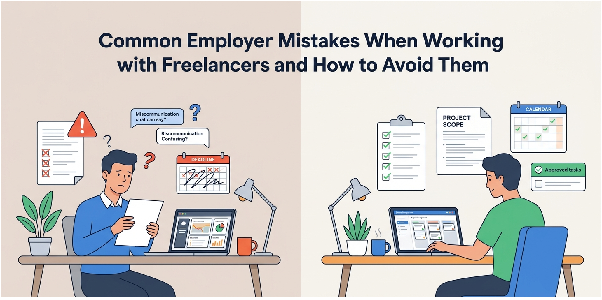
Common Employer Mistakes When Working with Freelancers and How to Avoid Them
Introduction: Hidden Challenges in the Gig Economy
With the ever-growing rise of freelance platforms and the inclination of companies towards project outsourcing, hiring specialized remote talent has become a key strategy for reducing costs and increasing agility. However, transitioning from a traditional workplace to working with freelancers is not always smooth. Due to a lack of familiarity with the specific dynamics of this type of collaboration, many employers make mistakes that not only lead to a waste of time and budget but can also result in complete project failure. In this comprehensive article, we explore common employer mistakes and provide practical solutions to prevent them.
1. Lack of Clarity in Project Definition (Briefing)
One of the biggest and most destructive mistakes is providing incomplete and vague instructions to the freelancer. In office environments, employees can clear up ambiguities through daily questions, but when working with a freelancer, an unclear Brief means hours of incorrect work. Employers who do not accurately document goals, target audience, brand tone, and final deliverables usually face results that are miles away from their expectations.
2. Micromanagement vs. Ghosting the Project
Extremes in managing freelancers are highly damaging. Some employers try to control every single working hour of the freelancer (micromanagement), which destroys the individual’s motivation and creativity, as freelancers fundamentally choose this path for work independence. On the opposite end, another group abandons the freelancer until the delivery day after assigning the project (Ghosting), losing the opportunity for course correction and feedback during the process.
Mathematical Analysis: The Cost of Rework Due to Poor Management
Let’s examine the financial impact of poor communication and lack of clarity using a simple mathematical model. If we denote the total cost of a project involving rework as $C_{total}$, this cost equals the initially agreed base cost ($C_{base}$) plus the cost of lost time and reworks:
$$C_{total} = C_{base} + \sum_{i=1}^{k} (T_{delay\_i} \times R_{hourly}) + C_{opportunity}$$
In this equation, $T_{delay}$ represents the hours of delay or rework due to misunderstanding the project, $R_{hourly}$ is the hourly labor rate (or delay penalties), $k$ is the number of revisions, and $C_{opportunity}$ is the business opportunity cost lost due to the product reaching the market late. When the employer does not spend enough time preparing an “accurate brief”, the variable $k$ increases sharply, and the final project cost ($C_{total}$) can grow to several times the initial budget ($C_{base}$).
3. Setting Unrealistic Deadlines and Excessive Pressure
Many employers assume that because freelancers work from home, they are available 24/7. Setting tight and illogical schedules not only drastically reduces the final quality of work but also causes tension in the working relationship. A professional employer should set reasonable Milestones in consultation with the freelancer themselves.
4. Excessive Haggling Over Price (Sacrificing Quality for Cost)
Although cost reduction is a primary reason for outsourcing, choosing the cheapest freelancer is not always the best strategy. Low-cost freelancers usually either lack sufficient experience or have to take on multiple projects simultaneously to make up for their income, which reduces their focus. Value should always take precedence over Price.
How to Avoid These Mistakes? (Practical Solutions)
Pre-Project Actions
- Drafting a Transparent Contract: Document all financial terms, intellectual property (copyright) rights, the permitted number of revisions, and data confidentiality (NDA).
- Defining Key Performance Indicators (KPIs): Specify exactly what metrics will be used to measure the project’s success.
During-Project Actions
- Breaking the Project into Smaller Phases: Instead of waiting to receive the entire project at the end of the month, review the deliverables weekly or in the form of milestones to ensure the path is correct.
- Structured Communication: Use project management tools like Trello or Jira and schedule short feedback meetings (like weekly stand-ups).
Frequently Asked Questions (FAQ)
Does the employer have the right to contact the freelancer outside of working hours?
No, unless emergency support or specific response hours were agreed upon in the initial contract. Respecting time boundaries is a key principle in retaining specialized talent.
What should we do if the freelancer’s output doesn’t match our requirements?
If your “initial brief” was accurate, you can request a revision (based on the number of times specified in the contract). However, if the mistake was due to your incomplete instructions, you must pay for the freelancer’s extra time to make corrections.
Conclusion
Ultimately, managing freelancers is a crucial skill in today’s business world. Employers who learn how to manage their projects by providing clear instructions, respecting the freelancer’s work independence, avoiding micromanagement, and building a trust-based relationship can fully utilize the unlimited potential of the Gig Economy. Avoiding these common mistakes not only optimizes costs but also leads to the creation of a powerful network of loyal professionals for the organization’s future projects.