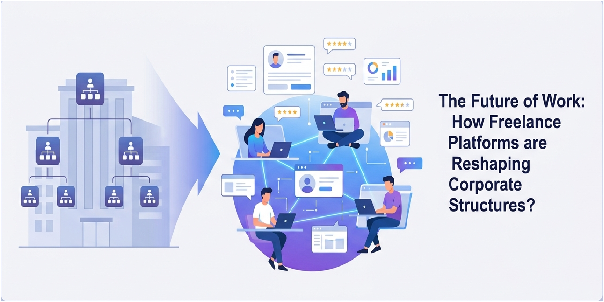
The Future of Work: How Freelance Platforms are Reshaping Corporate Structures?
Introduction: Paradigm Shifts in the 21st-Century Workplace
The business world is changing at an unprecedented pace. The traditional concept of “work,” which involved physical presence from 9 AM to 5 PM in an office, has given way to more flexible and dynamic models. At the center of this massive transformation are freelance platforms and the Gig Economy. Today, the future of work is no longer limited to full-time employment and rigid hierarchical structures; instead, it is moving towards distributed networks of global talent that are transforming corporate structures forever.
The Evolution of Freelance Platforms: From Micro-Tasks to Macro-Projects
In the past, outsourcing and using freelancers were limited to small, marginal tasks like designing a logo or translating a text. However, with the growth of communication technologies and the emergence of advanced platforms, this trend has changed. Now, major tech companies, startups, and even traditional organizations are entrusting their critical projects—such as software development, big data analysis, and marketing strategies—to freelance teams. These platforms act as a secure bridge, establishing trust and quality assurance between the employer and the professional.
Mathematical Analysis: Why Hybrid Structures Make More Economic Sense?
One of the primary reasons companies are shifting their organizational structure toward utilizing freelancers is cost optimization. Let’s examine this with a simple mathematical model. The total cost of a traditional internal team ($C_{trad}$) includes the sum of base salaries ($S$), benefits and insurance ($B$), and overhead/equipment costs ($O$) for $n$ employees:
$$C_{trad} = \sum_{i=1}^{n} (S_i + B_i + O_i)$$
Conversely, the cost of utilizing freelance talent ($C_{gig}$) is calculated based on an hourly or project rate ($R$) multiplied by the required hours or output ($H$) for $m$ freelancers:
$$C_{gig} = \sum_{j=1}^{m} (R_j \times H_j)$$
Since the variables $B$ (benefits) and $O$ (workspace overhead) in the freelance model drop to near zero, and the employer only pays for “useful time and exact output,” the equation $C_{gig} < C_{trad}$ holds true in most variable and agile projects. This economic formula is the driving engine behind the changing structure of companies.
The Impact of the Gig Economy on Human Resources (HR) Architecture
1. Shifting from Ownership to Access
In new structures, HR departments are no longer solely looking to hire people permanently; rather, their strategy has shifted toward “accessing the best talent when needed.” This approach allows companies to add highly specialized (niche) expertise to their team without the need for long-term commitments.
2. Infinite Agility and Scalability
Modern markets are highly volatile. A company that can quickly expand its team during a boom and reduce costs during a recession has guaranteed its survival. Freelance platforms provide this elastic scalability for corporate structures.
Management Challenges in New Freelancer-Based Structures
Despite the numerous benefits, transitioning to this structure is not without challenges. Companies must update their infrastructure to manage this new model:
- Coordination and Communication: Managing individuals across different time zones requires asynchronous communication tools and meticulous process documentation.
- Maintaining Organizational Culture: Transferring company values and culture to individuals who are not physically present in the office and are not official employees requires new leadership strategies.
- Data Security: Sharing sensitive information with individuals outside the organization demands robust Non-Disclosure Agreements (NDAs) and restricted access (Role-Based Access).
Frequently Asked Questions (FAQ)
Will freelance platforms completely replace internal employees?
No, the future of work will likely belong to “hybrid” models. The core of the company is managed by key employees, while executive, specialized, and project-based segments are outsourced to a network of freelancers.
How can the quality of freelancers’ work be guaranteed in the new structure?
By using rating systems on platforms, precisely defining Key Performance Indicators (KPIs) before starting work, and breaking large projects into smaller milestones for continuous output review.
Conclusion
Ultimately, the future of work belongs to organizations that embed flexibility into their DNA. Freelance platforms are not just a tool for finding cheap labor; they are catalysts that transform corporate structures from centralized, heavy entities into agile, innovative, and distributed networks. Managers who understand this paradigm shift today and align their infrastructure with the gig economy will be the market leaders of tomorrow.