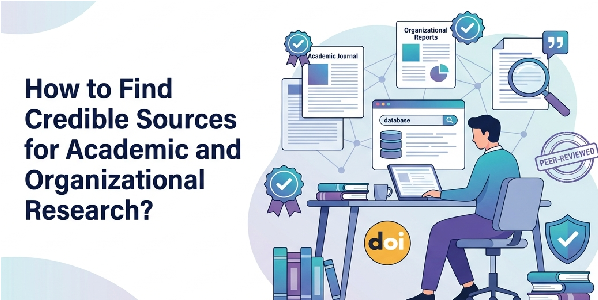
How to Find Credible Sources for Academic and Organizational Research?
Introduction: The Foundation of Solid Research
In the age of information explosion, access to data is no longer a challenge; rather, the main challenge is distinguishing “credible information” from a plethora of inaccurate, biased, or scientifically worthless data. Whether you are writing a university thesis or compiling a market report for your organization’s business development, the credibility of your output directly depends on the credibility of the sources you cite. In this comprehensive article, we explore golden strategies and tools for finding credible academic and organizational sources.
The Difference Between Academic and Organizational Sources
Before starting our search, we must know what type of source we are looking for:
- Academic Sources: Includes articles published in peer-reviewed journals, academic books, and dissertations. These sources focus on methodological rigor and theoretical foundations.
- Grey Literature & Industry Reports: Includes government reports, white papers, management consulting firm reports (like McKinsey and Gartner), and official statistics from central banks. These sources have more practical and commercial applications.
Top Databases for Source Searching
To find credible articles, you should move away from general search engines like Google and turn to specialized databases:
- Scopus and Web of Science: Two of the world’s most prestigious citation databases that index only journals with high scientific standards.
- Google Scholar: A free and accessible tool that searches almost all academic texts on the web, but requires more careful filtering by the researcher.
- PubMed: The best database for medical and life sciences research.
- Statista and World Bank Data: Unparalleled references for finding quantitative data, global statistics, and organizational reports.
A Mathematical Look at Academic Search Engines: The TF-IDF Algorithm
You might wonder how these systems find the most relevant articles when you enter your keywords into academic search engines. One of the foundational algorithms in information retrieval and natural language processing is the TF-IDF (Term Frequency – Inverse Document Frequency) algorithm. Its basic formula is as follows:
$$W_{i,j} = tf_{i,j} \times \log\left(\frac{N}{df_i}\right)$$
In this formula:
The variable $W_{i,j}$ is the weight or importance of word $i$ in document $j$.
The value $tf_{i,j}$ (Term Frequency) shows how many times your keyword is repeated in that specific article.
The value $N$ is the total number of articles in the database.
The value $df_i$ (Document Frequency) is the number of articles that contain your keyword.
This mathematical formula helps the database show you articles where your keyword is used in a meaningful and specialized way, rather than articles that merely use general conjunctions. Understanding this helps you choose more precise and specialized keywords for your search.
The CRAAP Test: A Metric for Evaluating Source Credibility
After finding a source, you should evaluate it using the international CRAAP test:
- Currency: Has the article been published recently? (For fields like Artificial Intelligence, old articles are worthless).
- Relevance: Does this source exactly answer your research question?
- Authority: Are the authors affiliated with reputable universities or organizations? Does the journal have an adequate Impact Factor?
- Accuracy: Are the claims supported by evidence and references?
- Purpose: Was the purpose of publishing this text scientific, or promotional and biased?
Conclusion
Finding credible sources is a skill acquired through practice and familiarization with the tools. Using specialized databases, critically evaluating sources with criteria like CRAAP, and avoiding predatory journals will ensure that you have built the foundation of your academic research or organizational report on solid and reliable ground.
Frequently Asked Questions (FAQ)
1. Is it permissible to use Wikipedia in academic and organizational articles?
No. Because Wikipedia can be edited by anyone, it is not considered a valid primary source. However, you can use it for an initial familiarization with concepts and use the References section at the bottom of its pages to find original and credible articles.
2. How can we assess the credibility of a journal?
By checking the journal’s Impact Factor in the JCR database, checking the Q (Quartile) index on the Scimago Journal Rank (SJR) website, and also ensuring the journal’s name is not on a list of predatory journals like Beall’s List, you can be sure of the journal’s credibility.
3. What is the difference between a simple Google search and Google Scholar?
A simple Google search shows results based on SEO and page popularity (like blogs and news sites), whereas Google Scholar restricts results solely to academic databases, scientific books, dissertations, and peer-reviewed articles, and also provides the ability to view the number of citations for each article.