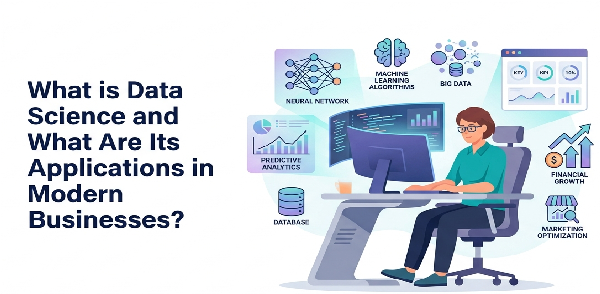
What is Data Science and What Are Its Applications in Modern Businesses?
Introduction: The Oil of the New World and the Rise of Data Science
Today, the famous phrase “data is the new oil” has become a reality more than ever before. Trillions of bytes of data are generated daily by users, smart devices, and enterprise systems. However, just as crude oil is worthless without refining, raw data does not contribute to business growth without analysis and processing. This is where Data Science steps in to extract golden insights from soulless numbers and figures for strategic decision-making.
What Exactly is Data Science?
Data science is an interdisciplinary field comprising a blend of statistics, mathematics, computer programming, and specialized business knowledge. The primary goal of data science is to discover hidden patterns, extract meaningful information, and predict future events based on structured data (like database tables) and unstructured data (like text, images, and videos). A Data Scientist uses advanced algorithms to turn data into stories that guide managers on the path to success.
Amazing Applications of Data Science in Modern Businesses
Leading organizations worldwide use data science to create a sustainable competitive advantage. Below, we discuss the most important applications of this science across various industries:
1. Customer Personalization
Companies like Amazon and Netflix use data science for their Recommendation Systems. By analyzing purchase history, search queries, and user behavior, they suggest products or movies that perfectly match the customer’s taste. This leads to a significant increase in sales and customer loyalty.
2. Demand Forecasting and Supply Chain Management
Retail and manufacturing businesses can use Predictive Analytics to forecast the demand for various products in upcoming seasons. This prevents overstocking or inventory shortages and drastically reduces operational costs.
3. Fraud Detection in Financial Services
Banks and financial institutions face a massive volume of transactions daily. Machine learning algorithms in data science can identify suspicious and unusual transactions in a fraction of a second, preventing financial fraud from occurring.
4. Dynamic Pricing
Airlines and ride-hailing services (like Uber) adjust their prices based on real-time supply and demand, traffic conditions, weather, and the time of day. This dynamic pricing strategy would be impossible without data science algorithms.
A Mathematical Look at Modeling in Data Science: Linear Regression
To better understand how data science works in forecasting, we can look at one of the simplest and most widely used algorithms: Simple Linear Regression. Suppose we want to predict sales volume ($y$) based on the advertising budget ($x$). The base formula for this model is as follows:
$$ y = \beta_0 + \beta_1 x + \epsilon $$
In this formula:
$y$ is the dependent variable (e.g., sales volume).
$x$ is the independent variable (e.g., advertising budget spent).
$\beta_0$ is the intercept (sales value when the advertising budget is zero).
$\beta_1$ is the slope of the line (indicating the impact of advertising budget changes on sales).
$\epsilon$ represents the model’s error (other factors affecting sales that are not included in the model).
Data science uses historical data to calculate the optimal values for $\beta_0$ and $\beta_1$ to provide the most accurate prediction for the future.
Conclusion: The Future of Businesses Depends on Data
In today’s highly competitive market, utilizing data science is no longer a luxury choice but a necessity for survival and growth. Businesses that can properly collect, analyze, and interpret their data will make faster, more accurate, and more profitable decisions. Investing in data science teams and analytical infrastructure will undoubtedly be one of the smartest strategies for managers in the coming decade.