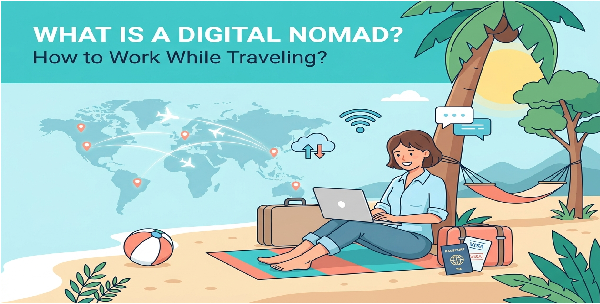
Introduction: Breaking Free from Location, A Dream Come True
Imagine starting your morning with the sound of ocean waves in Bali, opening your laptop in a local cafe, and doing your daily tasks for a company in London or New York. This lifestyle, which seemed like a sci-fi movie just a few decades ago, is known today as being a Digital Nomad. A digital nomad is an individual who uses telecommunications technologies and the internet to perform their work remotely while traveling continuously or periodically. In this comprehensive article, we explore the various dimensions of this lifestyle, the necessary tools, and its challenges.
Part One: Characteristics and Prerequisites for Becoming a Digital Nomad
Becoming a digital nomad is not just about buying a plane ticket and packing a laptop; it requires developing skills and creating personal infrastructure:
- Remote-friendly Skills: Programming, graphic design, content creation, digital marketing, consulting, and online teaching are among the most popular professions in this field.
- Self-discipline and Time Management: While traveling, distractions are abundant. A successful nomad must be able to establish a clear boundary between work time and leisure time.
- High Adaptability: Constantly changing environments, facing new cultures, and sometimes unpredictable problems (like internet outages) require a flexible and problem-solving mindset.
Part Two: How to Work While Traveling? (Equipment and Infrastructure)
To maintain your productivity while traveling, you need a mobile office. The most important items to have with you include:
- Appropriate Hardware: A lightweight laptop with a strong battery, high-capacity power banks, noise-canceling headphones, and a secure external hard drive.
- Stable Internet: Getting international or local SIM cards, using portable modems (MiFi), and identifying coworking spaces at your destination.
- Financial and Banking Management: Having international accounts, digital wallets, and credit cards with low currency conversion fees.
Part Three: Analytical Modeling of the “Nomad Sustainability Budget”
One of the biggest challenges for nomads is managing variable costs in different countries. To assess whether your income is sufficient for living in a specific destination, you can use the “Financial Sustainability Index” formula:
Financial Sustainability Equation
$$ S = I – (C_h + C_f + C_t + C_w) – R $$
In this analytical model:
$S$: Amount of savings or financial sustainability at the end of the month
$I$: Total monthly income (after taxes)
$C_h$: Housing costs (rent, hostel, or hotel)
$C_f$: Food and daily living expenses
$C_t$: Transportation and mobility costs (flights, trains, taxis)
$C_w$: Work-related expenses (internet, coworking spaces, VPN)
$R$: Risk reserve fund (for illness, laptop breakdown, and emergencies)
If $S > 0$, your lifestyle in that destination is sustainable. Professional nomads always choose destinations that offer a low $C_h$ and $C_f$ while maintaining a good quality of life (the concept of Geo-arbitrage).
Part Four: The Dark Side of the Coin; Challenges of Being a Nomad
This lifestyle is not just about beautiful Instagram photos; it has its own serious challenges:
- Loneliness and Isolation: Continuous distance from family and friends, along with constantly changing environments, can lead to feelings of loneliness and a decline in mental health.
- Time Zones: Coordinating business meetings with a team on another continent sometimes forces you to stay awake in the middle of the night.
- Visa and Tax Complexities: Tax laws for people without a fixed residence are very complicated. Also, getting a tourist visa that allows long-term work (nomad visa) is not easily possible in all countries.
Conclusion
The digital nomad lifestyle is a unique opportunity to combine a love for travel with career development. With careful financial planning, choosing the right equipment, and developing personal skills, the world can be turned into one big office. However, success on this path requires a realistic understanding of the challenges and having a Plan B for unforeseen circumstances.
Frequently Asked Questions (FAQ)
1. Do I have to be a programmer to become a digital nomad?
No. Although programming is one of the common professions, today writers, translators, graphic designers, accountants, language teachers, and even Virtual Assistants easily work as nomads.
2. What is a digital nomad visa?
A digital nomad visa is a permit issued by some countries (like Portugal, Estonia, the UAE, and Croatia) that allows individuals to reside in that country for a specific period (usually a year or more) and work remotely by proving their foreign income.
3. What are the best countries to start a nomad lifestyle?
Countries like Thailand (Chiang Mai), Indonesia (Bali), Portugal (Lisbon), and Mexico are considered the best destinations to start due to their reasonable cost of living, high-speed internet, abundant coworking spaces, and large nomad communities.