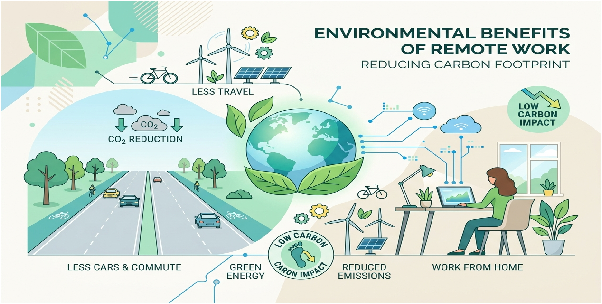
Environmental Benefits of Remote Work and Its Impact on Reducing Carbon Footprint
Introduction: Remote Work, A Solution for the Earth to Breathe
With the expansion of communication technologies and changing work patterns worldwide, Remote Work is recognized not only as an economic and welfare advantage for employees and organizations but also as a hidden savior for the environment. In an era where the climate change crisis and global warming have become one of humanity’s greatest challenges, reducing daily commutes and changing the structure of energy consumption can play a significant role in reducing the Carbon Footprint. In this comprehensive article, we examine the various dimensions of the positive impacts of remote work on the Earth’s ecosystem.
Part One: Reduction in Daily Commutes and Significant Drop in Pollutants
The most direct and tangible environmental impact of remote work is the elimination or significant reduction of daily personnel commutes to the workplace. This has positive consequences:
- Reduction in greenhouse gas emissions: A major portion of greenhouse gases, especially carbon dioxide ($CO_2$), is caused by the combustion of fossil fuels in private cars and public transportation systems.
- Improved air quality in metropolises: By reducing morning and evening traffic, the level of particulate matter and toxic pollutants (such as nitrogen oxides) in the air of large cities drops drastically.
- Reduction in noise pollution: Less traffic means a quieter city, which is vital not only for human mental health but also for urban wildlife and birds.
Part Two: Optimizing Energy and Resource Consumption in Organizations
The physical presence of hundreds of employees in an office tower requires the consumption of a massive volume of resources. Remote work changes this equation in favor of nature:
- Reduction in energy consumption in commercial buildings: Heating, cooling, and lighting systems in large office buildings consume a lot of electricity. By emptying or shrinking these offices, the energy consumption of urban grids becomes more optimized.
- Reduction in paper and plastic consumption: In remote work environments, processes are automatically digitized. Eliminating unnecessary printing and reducing the use of single-use plastic containers during office lunch hours significantly reduces the volume of generated waste.
Part Three: Analytical Modeling of Carbon Footprint Reduction
To better understand the scale of these impacts, we can calculate the net reduction in carbon emissions for a remote worker through an analytical formula. This equation shows the difference between the carbon saved due to non-commuting and the additional carbon produced at home.
Net Carbon Savings Equation
$$ \Delta C = (D \times F_c \times W) – E_h $$
In this analytical model:
$\Delta C$: Net carbon emission reduction (in kg)
$D$: Total daily round-trip commute distance to work
$F_c$: Vehicle carbon emission factor (per kilometer)
$W$: Number of remote working days per year
$E_h$: Additional carbon emissions from home energy consumption (heating/cooling/electricity) during working hours.
Studies show that in most geographical regions, the scale of this equation tips heavily in favor of carbon savings ($\Delta C > 0$), especially if the transportation system is based on fossil fuels.
Part Four: Challenges and the Rebound Effect
Despite all the benefits, remote work is not without challenges from an environmental perspective, and its “rebound effects” must be considered:
- Increased energy consumption in homes: Heating or cooling individual employees’ homes may consume more energy in some seasons than the centralized systems of an office building.
- Increase in Electronic Waste (E-waste): The need to equip homes with technology tools (second monitors, laptops, personal servers) can lead to an increase in the production of electronic waste.
- Urban Sprawl: By eliminating the need for a daily commute, some people may move to areas further from the city center, which could lead to the destruction of natural resources in the suburbs.
Conclusion
Remote work is undoubtedly one of the most effective tools available to combat climate change and rapidly reduce carbon footprints at both micro and macro levels. However, to maximize these environmental benefits, we need to adopt smart approaches. Hybrid work models, the use of renewable energy in homes, and optimizing the use of digital tools can ensure that the remote work revolution is a definitive win not only for the economy but also for planet Earth.
Frequently Asked Questions (FAQ)
1. Does home electricity consumption during remote work offset the benefits of reduced traffic?
According to research by the International Energy Agency, in most cases, the answer is no. The amount of energy saved by not using a personal car is much greater than the additional energy consumed to keep laptops running and lights on at home.
2. How can companies play a role in reducing the carbon footprint of their remote workers?
Companies can help their employees by offering green subsidies (such as allowances for purchasing home solar panels or energy-efficient equipment) and promoting a culture of optimal cloud server usage.
3. Is hybrid remote work better for the environment, or fully remote work?
The answer to this question depends on distances and infrastructure, but generally, fully remote work has the greatest impact on reducing pollutants; because in a hybrid model, office spaces must still remain lit and active while the employee also consumes energy at home on other days.