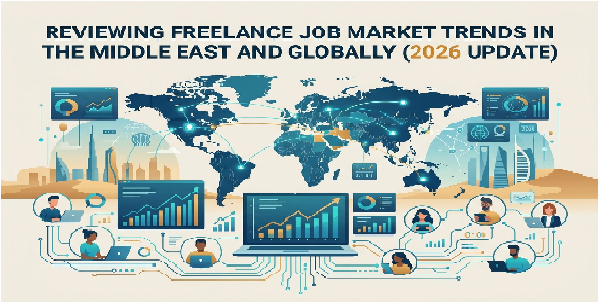
Reviewing Freelance Job Market Trends in the Middle East and Globally (2026 Update)
Introduction: The Freelancing Revolution in the New Economy
In recent years, the freelance job market has evolved from a marginal career option into one of the main pillars of the digital economy. With the advancement of technology, the changing attitude of the younger generation towards the concept of work, and the lasting impacts of the post-pandemic era, geographical boundaries in talent acquisition have faded more than ever. In this article, we aim to analytically review the latest global freelancing trends with a special focus on the potential and significant developments of this market in the Middle East region.
Part One: Key Global Trends in the Freelance Market
The global freelance market is evolving at an unprecedented rate. Understanding these trends is essential for success in this competitive space:
- Integration of Artificial Intelligence (AI) in Work: AI is no longer a threat; it is a tool freelancers use to increase productivity. Professionals who master AI tools are earning higher incomes.
- Shift from General Work to Specialized Niches: Global employers, instead of hiring jacks-of-all-trades, are looking for highly specific experts (such as smart contract developers or international SEO specialists).
- Change in Payment Models and Cryptocurrencies: The use of digital currencies and blockchain for paying freelancers to bypass banking fees and accelerate international transactions is heavily increasing.
Part Two: The Explosion of the Freelance Market in the Middle East
The Middle East is experiencing one of the fastest growth rates in the Gig Economy. A young population, high internet penetration rate, and changing economic policies of countries are the main drivers of this growth:
- Young and Tech-Savvy Population: Over half of the Middle East’s population is under 30 years old. This generation seeks financial independence and career flexibility, which freelancing provides.
- Digital Nomad Visas: Persian Gulf countries, especially the United Arab Emirates, by offering visas specifically for freelancers and digital nomads, are becoming global talent hubs.
- Growth of Local Platforms: In addition to global platforms like Upwork and Fiverr, regional platforms supporting Arabic and Persian languages are filling the gaps in the local market.
Part Three: Mathematical Modeling of Freelance Market Growth
To analyze and predict the size of the freelance market in the Middle East relative to the world, we can use the Compound Exponential Growth Model. Assume the market size is a function of time, internet penetration rate, and employer adoption coefficient.
Market Value Equation
$$ V(t) = V_0 \times e^{(r \cdot I \cdot C)t} $$
In this mathematical model:
$V(t)$: Freelance market volume and value at time $t$
$V_0$: Initial market value in the base year
$r$: The region’s baseline economic growth rate
$I$: Digital infrastructure and internet penetration index in the region (from 0 to 1)
$C$: Remote work culture adoption index by companies and employers
$t$: Time (in years)
Given that the $I$ and $C$ indices in the Middle East are currently increasing at a steep slope, it is predicted that the value of $V(t)$ in this region over the next five years will have a much faster growth compared to the global average.
Part Four: Challenges Facing Freelancers in the Middle East
Despite rapid growth, freelancers in this region face unique challenges:
- Financial Infrastructure Limitations: In some countries in the region, access to international payment gateways like PayPal is restricted.
- Lack of Comprehensive Support Laws: Unlike traditional employment, freelancers are often excluded from government insurance and retirement coverage.
- High Price Competition: The influx of cheap labor from some developing countries causes project prices to drop on global platforms.
Conclusion
The freelance job market in the Middle East and globally is undergoing a historical transition. Companies have realized the value of flexibility and access to borderless talent, and the young workforce prefers independence over false job security. To succeed in this new ecosystem, freelancers must continuously update their soft skills, AI knowledge, and deep expertise. The future belongs to those who can adapt to the speed of change.
Frequently Asked Questions (FAQ)
1. What are the highest-paying freelance fields currently?
Specialties related to artificial intelligence, software and blockchain development, data analysis, and advanced digital marketing are at the top of the highest-paying skills globally and in the Middle East.
2. How can one overcome the challenges of receiving foreign currency payments in the Middle East?
Many freelancers today use reputable financial intermediary platforms, cryptocurrencies (like Tether or Bitcoin), or register companies in facilitating countries (if legally possible) to receive their wages.
3. Will AI replace freelancers?
AI will not replace humans who use it; rather, it will replace those who refuse to adopt and learn it. AI is a tool to increase the speed and quality of a professional freelancer’s work.